

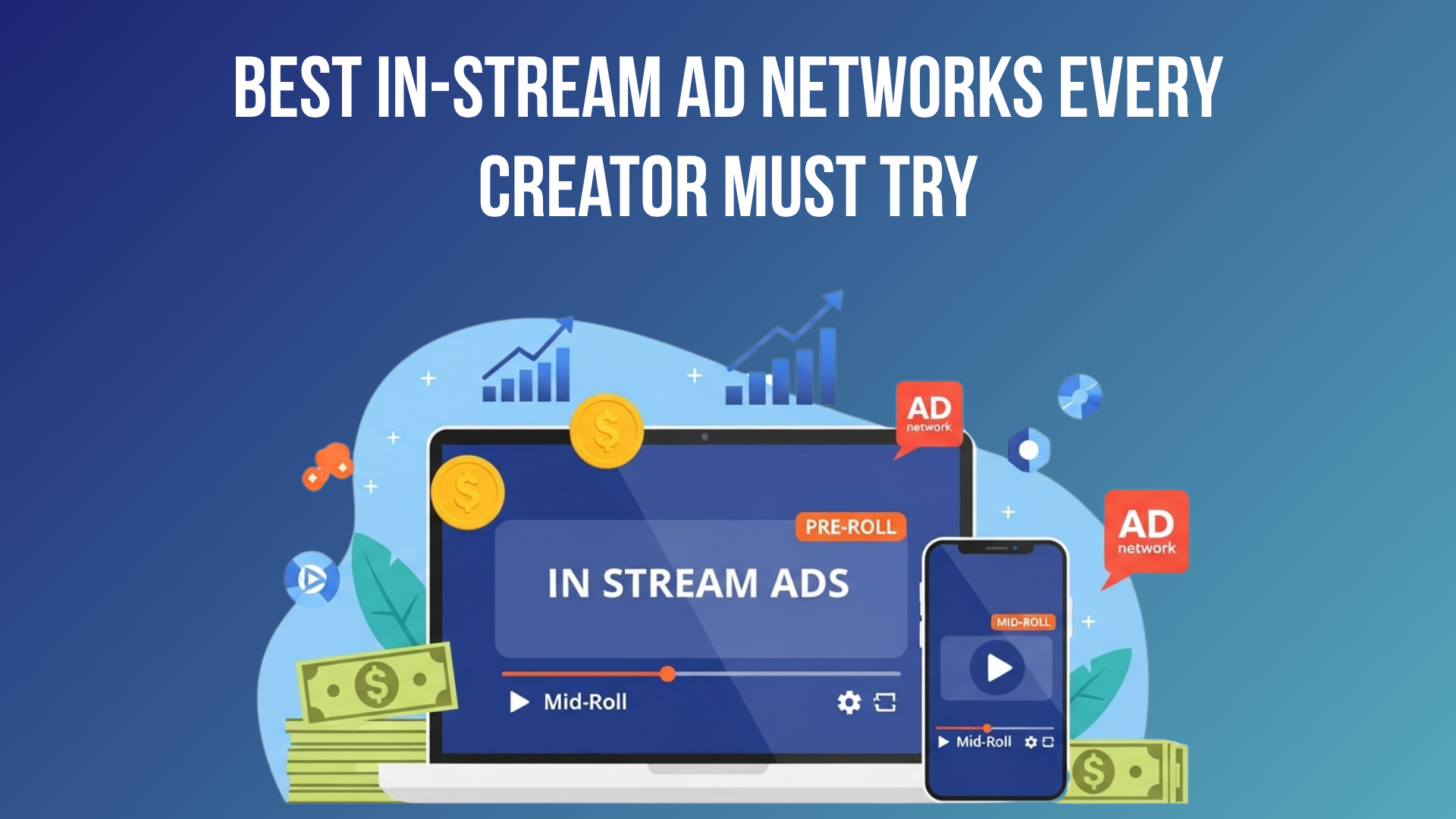
Video content is king, and in 2026, in-stream ads (ads inside video content) are among the most effective monetization tools for creators and publishers. Whether you run an educational site, a niche blog with embedded video, or a media portal, placing ads before, during, or after videos can turn viewership into real earnings.
But the challenge isn’t just adding ads — it’s choosing the right in-stream ad platform. Each network differs in ad formats, revenue share, targeting, integration complexity, and how friendly it is to publishers of different sizes.
This article will guide you through how in-stream ads work, what to consider when choosing a platform, and the top 5 in-stream ad networks in 2026 that you should try. By the end, even if you’re just starting, you’ll have a clear roadmap to integrate video ads and grow with confidence.
What Is an In-Stream Ad Network?
It is a system or service that allows publishers (websites, apps, video platforms) to place video advertisements inside their videos — before (pre-roll), during (mid-roll), or after (post-roll). These networks handle the connection between you (publisher) and advertisers, decide which ads to show, and track performance. They manage ad inventory, bidding, targeting, delivery, and reporting.
Key Types of In-Stream Ad Networks:
Before we jump into the top 5 in-stream ad platforms of 2026, it’s worth knowing why this matters. Different ad types work for different videos — short clips might suit pre-roll, but not mid-roll. Knowing the basics helps you pick a network that actually supports the formats you need and clears up confusion. These are real ad systems that place and manage video ads, not shady bots.
1. Pre-Roll Networks
- Ads that play before the main video content begins.
- Common, usually short (5–30 seconds).
- Good for new content because the viewer hasn’t skipped yet.
2. Mid-Roll / Mid-Video Networks
- Ads shown during the video (at natural breaks).
- Best for longer videos (5+ minutes).
- These tend to earn more per impression because viewer engagement is already established.
3. Post-Roll Networks
- Ads are displayed after the video ends.
- Risk: many users leave immediately, so the view numbers drop.
4. Overlay / In-Video Ads
- Semi-transparent banners or text overlays that appear while the video plays.
- Less intrusive, can run alongside viewable video content.
5. Out-Stream Video Networks
- Video ads are placed in non-video content (e.g., inside an article or between paragraphs) using in-stream ad systems.
- Useful when a page doesn’t always have a full video — you can still show video ads in context.
6. Programmatic / Exchange-Based Networks
- These networks use automated auctions (real-time bidding) to decide which ad to show.
- Many platforms and ad exchanges operate this way, letting many advertisers compete for each video impression.
Now you’ve seen the best options, you know how pre-roll, mid-roll, post-roll, and out-stream ads differ. Matching your content and audience to the right platform helps you earn more and keep viewers happy with quality, legitimate ads.
How In-Stream Advertising Works?
- You have video content (a tutorial, vlog, or presentation).
- You integrate or embed a video player that supports ad insertion (often via VAST/VMAP protocols).
- You sign up with a platform/ad network that supplies video ads to fill ad slots.
- When a user watches the video, ads play (pre-roll, mid-roll, post-roll).
- The platform tracks views, ad impressions, click-throughs, and other metrics.
- You get paid based on the number of valid ad views or completions, minus the network’s share.
Because video ad inventory is in high demand, especially from brands wanting engagement, CPMs (cost per thousand impressions) tend to be higher than many standard display ads.
Factors to Consider Before Choosing an In-Stream Ad Platform:
Here are some critical elements to evaluate (with examples):
- Niche / Content Topic: Some topics (finance, tech, legal, health) attract premium advertisers and higher CPMs. Your niche strongly affects your revenue potential.
- Audience Geography: Ads shown to viewers in high-income countries (USA, UK, Canada, Western Europe) often pay more than to audiences in lower-income geos.
- Ad Formats Supported: Pre-roll, mid-roll, post-roll, overlays, out-stream — more formats mean more flexibility and revenue options.
- Revenue Share & Fill Rates: A big-name platform might offer a lower share or lower fill in your region. Sometimes a smaller platform with higher fill is better.
- Integration & Technical Setup: How easy is embedding the ad tags or using their video player or SDK? Does it slow down page load?
- Reporting & Analytics: You’ll need dashboards showing impressions, CPMs, ad viewability, drop-offs, and click-throughs. Without data, you can’t optimize.
- Policy, Monetization Rules & Appeals: Platforms may reject ad placement on certain kinds of content (violence, political, adult). Knowing their appeals process matters.
- Payout Terms & Minimums: Platforms differ in payment thresholds (e.g., $50, $100) and payout schedules (net-30, net-45, etc.). For smaller creators, a low threshold is important.
- Support & Reputation: Because video ads involve many moving parts, good technical support and reliability are vital.
Comparison Table of In-Stream Ad Networks:
| Platform | Context / Strength | Revenue Share / CPM (typical) | Best For | Notes / Trade-offs |
| JWP Connatix | Full video + ad + discovery stack | ~55–70% share (varies by deal) | Premium publishers wanting player + ads | Strict entry, better in Tier-1 geos |
| Primis | Discovery + in-stream ads | ~50–65% share (market dependent) | Sites needing both discovery & monetization | Strong in many geographies, variable support |
| Magnite / SpotX | Programmatic video exchange | Depends on floors & deal terms | Large publishers or scaling sites | Requires volume to get the best rates |
| VDO.AI | Flexible ad formats (in-stream, out-stream) | Varies by region, niche | Publishers seeking modern, varied ad types | May have lower fill in small markets |
| OpenX Video (with VAST support) | Ad exchange/video monetization | Depends on the deal | Tech-savvy publishers wanting a custom setup | Needs good tech infrastructure |
(Note: revenue share and CPMs depend heavily on geography, niche, traffic quality, and deal terms.)
1. JWP Connatix
JWP Connatix is a combination of JW Player and Connatix, offering an integrated video player plus monetization and discovery tools. It’s become a go-to for publishers who want a powerful stack — not just ads but content recommendation, analytics, and monetization built in.
Features:
- Built-in video player + ad engine
- In-stream ad formats (pre, mid, post, overlays)
- Discovery modules (video suggestions to retain users)
- Fraud protection & brand safety
- Custom analytics & dashboards
Reputation:
Many publishers praise its all-in-one stack and good monetization for premium content. After the merger, Connatix’s video reach reportedly expanded. Some feedback notes that the platform is strongest in the U.S. and other Tier-1 geos.
Pricing Overview:
- Revenue share (varies by deal)
- Minimum traffic or video impression requirements
- Payment terms often ~NET-15 or NET-30
Pros:
- All-in-one video + monetization + discovery
- Good ad demand in premium niches
- Retention through discovery features
Cons:
- Stricter entry/quality floors
- CPMs drop significantly in lower-income geos
- Requires technical integration (custom player, SDK)
Best For: Publishers with quality video content who want control over player + ads + discovery, especially in the U.S./UK markets.
JWP Connatix is among the top platform choices if you can meet its entry standards. For many creators aiming high, it’s worth the setup effort.
2. Primis
 Primis is a video discovery engine that pairs content discovery with in-stream ads. It’s used by many publishers worldwide to not only monetize existing video content but also keep users watching longer via recommended videos.
Features:
- Discovery modules + in-stream ad insertion
- Multiple ad formats: pre-roll, mid-roll, overlays, out-stream
- Real-time analytics & metrics
- Integration via scripts/plugins
- Fraud detection & brand safety
Reviews / Reputation:
Publishers like Primis for ease of integration and its ability to boost view time. However, in the U.S. verticals where competition is high, some report CPM pressure and demand for higher-quality content.
Pricing Overview:
- Revenue share / CPM-based
- Payment frequency: often ~NET-15 or NET-30
- CPMs vary by niche, geography
Pros:
- Good for publishers with modest traffic
- Combines monetization + discovery
- Flexible formats
Cons:
- CPMs drop in less desirable geographies
- Support and responsiveness vary
- Ad quality ties closely to traffic quality
Best For: Sites making niche or long-form video content that need both monetization and content retention strategies.
Primis is a strong choice, especially when big ad networks undervalue your content. Just be realistic about CPMs in your market.
3. Magnite / SpotX

SpotX (now part of Magnite) is a programmatic video exchange that connects publishers to global advertisers via real-time bidding. It’s designed for scale and performance across devices and formats.
Features:
- Programmatic auctions for video inventory
- Support for VAST / VMAP standards
- Cross-device ad serving (web, mobile, CTV)
- Analytics dashboards & transparency
- Custom deals & floors
Reviews / Reputation:
It’s viewed as a robust, enterprise-level option. Many large publishers rely on SpotX for video monetization. Smaller publishers may find minimum volume or revenue floors challenging.
Pricing Overview:
- CPM model, often with floors and buffer
- Payment terms: ~NET-30 or negotiated
- Revenue share depends on deals and floors
Pros:
- Massive advertiser pool
- Flexible formats and scale
- Good for large content operations
Cons:
- Might not pay well for low-volume creators
- Floors or minimums may exclude small sites
- Requires technical setup and volume
Best For: Publishers with solid traffic looking to scale video monetization across platforms.
SpotX / Magnite is a powerhouse for video publishers. If you can hit their volume and quality thresholds, the potential upside is significant.
4. VDO.AI
VDO.AI focuses on modern video ad formats and gives publishers flexibility with in-stream + out-stream video placement. They aim to help people monetize even non-video content by embedding videos into article pages (out-stream) while still supporting normal in-stream ads.
Features:
- Support for in-stream, out-stream, and overlay formats
- Responsive video ad units for different screens
- Analytics, viewability tools
- Easy integration (JS, tags)
Reputation:
VDO.AI is often praised for offering video monetization even to publishers without heavy video libraries. Some publishers love the out-stream support; others note that fill rates depend heavily on geography and niche.
Pricing Overview:
- Revenue share / CPM model
- Payment terms: often ~NET-30 or as agreed
- CPMs vary by vertical and geography
Pros:
- Allows monetizing non-video pages via out-stream
- Flexible ad formats
- Good for publishers transitioning to video
Cons:
- Lower fill or CPM in less advertiser-rich regions
- Requires careful ad placement to avoid disruption
- Analytics are sometimes less deep than enterprise tools
Best For: Publishers who want to monetize both video pages and articles via embedded video ads.
VDO.AI offers a bridge between article + video monetization. If your site is in transition, this platform can help you get earnings from more pages.
5. OpenX (Video / Ad Exchange Option)

OpenX is a respected ad exchange that supports video inventory via VAST tags. For creators comfortable with ad-tech, it offers a flexible, scalable way to monetize in-stream spots across many demand sources.
Features:
- Supports VAST for in-stream video
- Integration with demand partners, DSPs
- Real-time bidding and waterfall setups
- Publisher dashboards & analytics
Reputation:
OpenX has long been respected in display ad exchanges. Their video offering is seen as robust for advanced publishers. It’s not as plug-and-play for beginners but powerful in the hands of experienced publishers.
Pricing Overview:
- Auction-based CPMs
- Payment terms: typical exchange schedules (e.g., monthly, NET-30)
- Revenue share depends onthe demand stack
Pros:
- Many demand sources, high competition
- Flexible, scalable for advanced users
- No “locked-in” stack
Cons:
- Less friendly for beginners
- Need technical setup and optimization
- Economics can vary widely by traffic
Best For: Publishers who are comfortable with ad-tech and want full control over monetization flow.
OpenX is a solid option for technically savvy creators who want broad ad inventory access and control over how ads are served.
Tips to Maximize Earnings with In-Stream Ads
Want to squeeze the most revenue out of your in-stream ads? A few smart habits can make a huge difference.
- Choose niches that attract strong advertiser budgets (e.g., finance, health, business).
- Drive traffic from high-CPM countries or global audiences.
- Focus on high-retention, engaging content (viewers stay through mid-roll).
- Test multiple platforms side-by-side.
- Monitor CPMs, fill rates, and drop-offs. Switch or adjust if one underperforms.
- Stay clean on policies, avoid reused content, and respect ad guidelines.
Applying these simple practices will help you unlock higher CPMs, keep advertisers happy, and steadily grow your ad income over time.
Common Mistakes & Risks
Even top creators slip up with in-stream ads. Small mistakes — like using shady growth services or cramming too many ads into a video — can kill CPMs, hurt viewer trust, or even trigger demonetization.
Knowing these risks upfront helps you protect your revenue and audience.
- Relying on auto-follow / bot services (these break policy).
- Low-quality content expecting high CPMs.
- Overloading video with too many mid-rolls (hurts retention).
- Violating platform ad policies (leads to demonetization).
- Not watching analytics or not adjusting strategy.
Conclusion:
In-stream advertising is one of the best paths for video publishers to monetize in 2026 — especially outside YouTube’s ecosystem. The five platforms above each shine in different scenarios: JWP Connatix and Primis for integrated video + discovery, SpotX for programmatic reach, VDO.AI for flexibility, and OpenX for ad-tech control.
I chose these in-stream ad networks because they’re trusted industry leaders, offer competitive CPMs, and give creators flexible formats with reliable payouts — making them the smartest picks for 2026.
The key is simple: pick one or two networks, integrate carefully, monitor your metrics, and double down on what works. With the right in-stream platform, you can turn your content into a reliable stream of growing revenue.
Frequently Asked Questions (FAQs):
What is an in-stream ad network?
It’s a platform that places video ads inside your videos (pre-roll, mid-roll, post-roll) and connects publishers with advertisers.
Do smaller sites benefit from in-stream ads?
Yes, especially specialized or niche sites. Networks like Primis / VDO.AI help monetize traffic that large ad systems skip.
How much can I earn (CPM)?
Your earnings depend on your niche, audience location, and content quality. In top niches (finance, health, tech) and Tier-1 countries (US, UK, Canada), CPMs often range from $10–$20+ per thousand views. In lower-CPM regions or less competitive niches, expect $2–$8 per thousand views.
Do in-stream ads slow down my page or app?
Poorly integrated ad players can increase load times. Always use asynchronous loading or lightweight players and test your site’s Core Web Vitals to keep latency low.
When should I switch ad networks or platforms?
If you see CPMs consistently dropping, fill rates falling below 50%, or poor user experience for several weeks, it’s time to test another network or renegotiate terms.
Do I need my own videos to run in-stream ads?
Not always. Some networks provide a built-in video library or out-stream units so you can monetize even non-video pages.
Are these networks safe and policy-compliant?
Reputable networks partner with verified DSPs and follow industry standards like VAST/VPAID. Always read each platform’s policy and keep your content original to avoid demonetization.
How fast will I get paid?
Payment terms vary: many top networks pay NET-30 to NET-45. Check minimum payout thresholds and payment methods before signing up.
