
Imagine you’ve spent hours designing what seems like the perfect banner ad — eye-catching colors, a catchy headline, and an irresistible offer. You hit publish, expecting your audience to click immediately.
But days later… nothing.
The impressions are there, but your CTR is painfully low. You start wondering, “Do people even see my ads?”
You’re not alone.
According to WordStream’s 2024 report, the average CTR for display ads is just 0.06%, down sharply from over 1% a decade ago. That decline continues into 2025, and the main reason is something every marketer dreads — banner blindness.
It’s not that your audience hates ads — it’s that their brains have trained themselves to ignore them, especially when they appear in predictable spots.
The good news? You can fix it.
In this guide, you’ll learn what banner blindness really means and why it happens, both psychologically and technically.
You’ll also discover 10 proven ways to reduce banner blindness, see real-world examples from brands that overcame it, and learn how to combine content, creativity, and data to boost your CTR. Let’s get started.
What Is Banner Blindness?
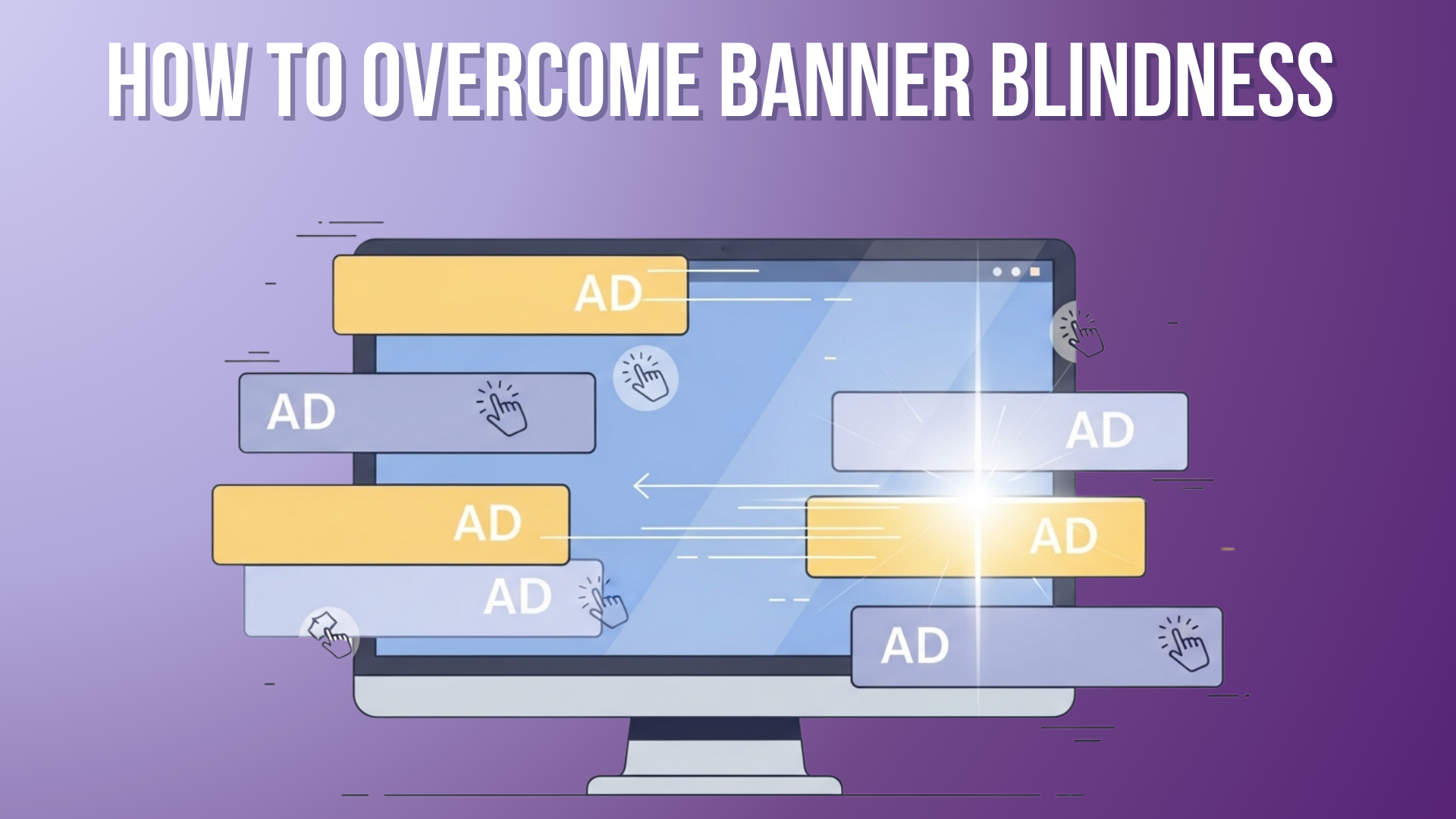
Banner blindness is a phenomenon where website visitors consciously or unconsciously ignore banner-like ads while browsing.
Think of it like driving past the same billboard every day — after a while, your brain stops noticing it.
Online, the same happens. Users automatically skip sections of a webpage that look like ads, even if those sections contain useful information.
A 2024 Nielsen Norman Group study found that 82% of users ignore banner-like elements, regardless of their content or placement.
In short, Banner blindness is the digital version of tuning out visual noise.
This natural human behavior poses a serious challenge for advertisers who rely on banners, display ads, or even pop-ups.
To effectively reduce banner blindness, you must first understand why it happens.
Why Does Banner Blindness Happen? (The Psychology Behind It)
Banner blindness isn’t just a design problem — it’s rooted in how our brains process information.
Here are the five major causes behind it:
1. Selective Attention
Human brains are wired to focus only on information relevant to a current goal.
When users browse, they’re on a mission — to read an article, check a price, or complete a task.
Anything outside that goal, especially traditional ad spaces, gets filtered out automatically.
This psychological behavior is called selective attention, and it’s one of the biggest reasons banner ads are skipped.
2. Ad Fatigue
We live in an age of ad overload. An average person sees over 6,000–10,000 ads per day (Forbes, 2024).
That constant exposure causes ad fatigue — the brain starts tuning out repetitive, generic, or visually similar content.
The result? Even the best-designed ad blends into the background.
To reduce banner blindness, brands must keep their visuals fresh and engaging.
3. Predictable Ad Placement
People know where ads usually appear — top banners, right-hand sidebars, or at the bottom of a page.
Because of this predictability, users instinctively avoid looking at those areas, similar to how you might skip a TV commercial you’ve seen too often.
The key here? Surprise your users. Place ads in natural reading zones or embedded within content to catch genuine attention.
4. Lack of Relevance
If your ad isn’t relevant, it won’t matter how great it looks. Generic messages like “Buy Now” or “Limited Offer” rarely resonate. But if the content speaks to a specific user’s problem or interest, they’re more likely to notice and click.
Relevance is the ultimate weapon to reduce banner blindness — and it starts with data-driven personalization.
5. Poor Mobile Experience
More than 70% of global web traffic comes from mobile devices (Statista, 2025).
If your banners aren’t mobile-friendly, they’ll be ignored instantly. Text too small, slow load times, or buttons that can’t be tapped easily are all deal-breakers.
A poorly optimized ad isn’t just ignored — it frustrates users and harms brand perception.
Why Banner Blindness Hurts Your CTR (and Your Business)
Banner blindness does more than reduce clicks — it damages your overall marketing performance.
When users ignore your ads:
- Your ad spend increases without meaningful returns
- Conversions drop, hurting ROI
- Brand visibility weakens, leading to fewer repeat visitors
A HubSpot study found that non-personalized display ads have 43% lower engagement than those tailored to user interests.
So ignoring banner blindness isn’t just a design mistake — it’s a budget leak.
Now, let’s dive into the real-world solutions.
10 Proven Strategies to Reduce Banner Blindness and Boost CTR
Below are ten actionable, research-backed strategies you can implement right away to make your ads stand out, attract attention, and drive clicks.
1. Optimize Your Ad Placement
Most marketers stick to default banner placements — top or sidebar. But that’s exactly where users expect ads to be, and where their eyes don’t go.
Instead, place ads within the content flow, such as mid-article sections or between paragraphs.
According to Chartbeat, ads placed inside the main reading area get up to 3x more visibility than traditional top banners.
Pro Tip: Use heatmap tools like Hotjar or Crazy Egg to identify where users’ attention naturally goes, and position your ads there.
This strategy alone can significantly reduce banner blindness by aligning ads with the user’s reading path.
2. Use Native Advertising
Native ads blend seamlessly with the surrounding content. They don’t disrupt the experience — they enhance it.
For example, a native ad on a blog might look like a helpful article suggestion rather than a promotional banner.
Platforms like Outbrain, Taboola, and Revcontent help brands create these subtle, content-driven ad experiences.
Research shows native ads boost purchase intent by 53% compared to traditional display banners.
In short, native ads reduce banner blindness by appearing where users expect to find valuable content, not interruptions.
3. Personalize Your Ads with Data
Personalization is one of the most powerful ways to make your ads stand out.
When an ad feels personal — like it’s speaking directly to you — it grabs attention instantly.
Use tools like Google Ads Audience Segments or Meta Pixel Data to deliver location, interest, or behavior-based ads.
For instance, instead of saying: “Buy Our Fitness App Now!”
Try: “Hey, Austin! Want to stay fit at home? Try our new AI-powered fitness app.”
According to Epsilon Research, 80% of consumers are more likely to click on ads that offer personalized experiences.
4. Add Interactivity and Motion
Static ads are easy to scroll past. But movement triggers curiosity.
You can reduce banner blindness with:
- Animated banners (GIFs)
- Short autoplay videos (muted)
- Interactive polls or mini quizzes
Outbrain reports that interactive “click-to-watch” ads have 97% higher engagement than static ones.
Even subtle animations — like a glowing CTA button or slow image fade — can make users stop and look.
5. Leverage Data and Behavioral Insights
Running ads without analyzing performance is like shooting arrows in the dark.
Use analytics to find out:
- Which placements get the most attention
- What time of day does your audience engage most
- Which demographics click more
Tools like Google Analytics 4, SEMrush Advertising Research, or Microsoft Clarity help track these behaviors.
Then, refine your ads accordingly. Data-driven campaigns not only reduce banner blindness — they increase ROI.
6. Refresh Your Creative Design Regularly
Even your best-performing ad can go stale.
According to HubSpot, refreshing creatives every 30–45 days can boost CTR by 28% on average.
Change things like:
- Ad colors and background patterns
- Copy tone (urgent vs emotional)
- CTA phrases (“Learn More” → “Start Your Free Trial”)
The key is to maintain familiarity while introducing novelty — enough to reset users’ attention without confusing them.
7. Make Ads Mobile-Friendly
If your ad isn’t optimized for mobile, it’s already invisible to most users.
Ensure that your banners:
- Have readable text (14–16px minimum)
- Load in under 2 seconds
- Feature tappable CTAs
- Use vertical or square aspect ratios for scrolling feeds
According to Google Ads data, mobile-optimized designs see 2.5x higher CTR than desktop-first formats.
This one step alone can dramatically reduce banner blindness for mobile-heavy audiences.
8. Use Emotional Storytelling
Emotions grab attention faster than logic. Instead of showcasing features, tell stories of transformation or relief.
Example:
“Tired of sleepless nights? Discover how over 20,000 people improved sleep naturally with our app.”
Stories humanize your message and create an emotional connection.
According to Forbes (2024), emotion-driven ads outperform logical ones by 31% in conversion rates.
So don’t just sell — make your audience feel.
9. Experiment and A/B Test Everything
You can’t fix what you don’t measure.
A/B testing lets you test multiple versions of your ad to see which performs best.
Try experimenting with:
- Headlines (questions vs benefits)
- CTA colors and wording
- Ad sizes or placements
Even a small change — like button color — can increase CTR by 20%. Keep testing and optimizing to reduce banner blindness over time.
10. Combine Content Marketing with Advertising
The most trusted brands blend content and ads naturally.
When users already trust your content — blogs, videos, or newsletters — they’re far more open to engaging with your ads.
This strategy, known as content-driven advertising, makes your brand part of the learning experience, not an interruption.
According to DemandMetric, content marketing generates 3x more leads than display ads alone — and costs 62% less.
So, integrate your banners into educational or story-driven content that adds real value.
Case Study: How SNCF Connect Beat Banner Blindness
In 2022, SNCF Connect, France’s largest travel platform, faced a problem — their traditional display ads were being ignored during a major rebranding campaign.
They partnered with Outbrain to test Click-to-Watch (CTW) video ads — short, interactive clips users could choose to watch.
The results were dramatic:
- 45% increase in ad recall
- 23% rise in brand awareness
- 33% improvement in brand association
This campaign proved that interactive, personalized ad formats don’t just reduce banner blindness — they enhance engagement and long-term brand connection.
Conclusion:
Let’s face it — people aren’t ignoring your ads because they hate them. They’re ignoring them because their brains are overloaded. Banner blindness is the natural defense mechanism against irrelevant noise.
But by focusing on relevance, design freshness, personalization, and interactivity, you can reduce banner blindness and create ads that truly connect.
Start small. Test. Learn. Optimize.
Every improvement — every small change in copy, design, or placement — brings you closer to breaking through the clutter.
Remember: Don’t just advertise. Engage, educate, and emotionally connect. That’s how modern marketers win clicks, trust, and conversions.
FAQs on Reducing Banner Blindness and Boosting CTR
1. What causes banner blindness?
Banner blindness happens when users subconsciously ignore predictable or irrelevant ads due to selective attention and overexposure.
2. How can I increase my CTR fast?
Focus on smart ad placement, emotional storytelling, mobile optimization, and A/B testing.
3. What’s a good CTR for display ads in 2025?
According to WordStream, the average CTR is around 0.06%, but optimized campaigns can achieve 0.5–1%.
4. Do interactive ads really work?
Yes! Interactive ads like polls, playable videos, and quizzes see up to 97% higher engagement than static banners.
5. Is banner advertising still effective?
Absolutely. When done right — with personalization, native formats, and storytelling — banner ads remain one of the most cost-effective awareness tools.