

Imagine spending money every month on digital ads and still not getting clicks, conversions, or real ROI. You feel confused — why isn’t your strategy working? Why is your budget disappearing without meaningful results?
This is a real struggle in 2026.
Advertisers often face wasted ad spend, while publishers deal with unsold, wasted inventory. Both sides lose money for different reasons, but usually because they don’t fully understand how their advertising platforms work.
Many marketers hear terms like ad network, ad exchange, and programmatic advertising, but the differences are not always clear. Choosing the wrong model can mean lower transparency, weaker targeting, or missed revenue opportunities.
But when you clearly understand how ad networks and ad exchanges actually function — and where each one fits — you can make smarter decisions and protect both your budget and your inventory.
What Is an Ad Network?
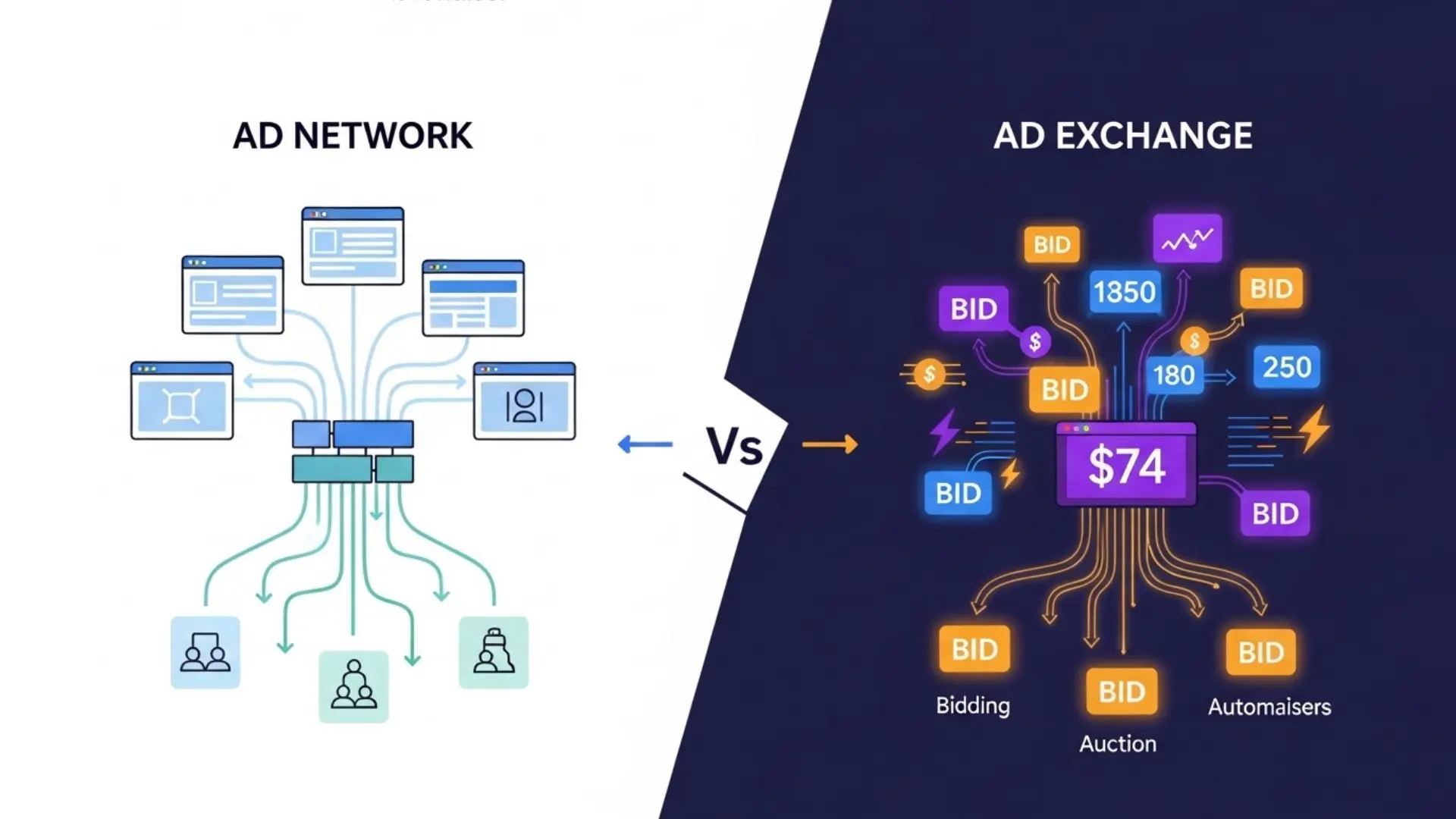
An ad network is a service that connects advertisers with websites (publishers) where ads can be displayed. Think of it as a middleman — like a traffic manager who collects ad space from many publishers and then sells that space to advertisers.
Ad networks bundle inventory (online ad space) from many websites into packages that advertisers can buy based on things like:
- audience demographics
- interests
- traffic quality
This means advertisers don’t choose specific placements — they buy a package from the network.
Examples include major ad networks like:
- Google AdSense
- Adcash
- AppLovin
- Facebook/Instagram Ads
Key point: An ad network aggregates inventory and sells it to advertisers.
What Is an Ad Exchange?
An ad exchange is like a digital marketplace or auction house where advertising inventory is bought and sold automatically in real time. Instead of buying a pre-packaged deal, advertisers bid on individual ad impressions as they happen.
This real-time process is called RTB (Real-Time Bidding).
In simple terms:
- Publishers list their ad space in the exchange
- Advertisers bid in real time for each impression
- The highest bidder wins the ad placement
Examples of ad exchanges include:
- Google Ad Exchange
- AppNexus
- OpenX
- Microsoft Advertising Exchange
Key point: An ad exchange is a marketplace where advertisers compete in live auctions to buy ad impressions.
Ad Network Vs Ad Exchange (Quick Overview)
| Feature | Ad Network | Ad Exchange |
| What it is | Middleman bundling inventory | Real-time marketplace |
| Pricing | Fixed CPM/CPC | RTB auctions |
| Transparency | Limited | High |
| Control | Less control | More control |
| Best for | Beginners, fixed pricing | Advanced targeting & transparency |
| Inventory | Mostly premium | Premium + remnant |
| Technology | Manual packaging | Automated, data-driven |
This table helps instantly compare the two before deep diving.
Why This Comparison Matters in 2026
Programmatic advertising — buying and selling ads automatically via software — now dominates digital marketing.
Here are key industry facts you must know:
- Programmatic advertising spend is projected to reach over $650 billion globally by 2025, making up over 82% of total digital ad spend.
- In the U.S., over 90% of digital display ad spending is now programmatic.
- Real-time bidding accounts for 60-72%+ of programmatic transactions worldwide.
- Mobile devices deliver around 63-71% of programmatic impressions, showing how ads have shifted to smartphones and tablets.
This rapid growth makes understanding ad networks vs ad exchanges more important than ever — especially for advertisers who want results and publishers who want revenue.
How Ad Networks Work
- Inventory Collection: Publishers sign up and add their ad inventory (space to show ads). The network collects this across many sites.
- Packaging & Targeting: The network groups inventory based on niches or audience data (like tech sites, gaming blogs, etc.).
- Sell to Advertisers: Advertisers buy these inventory packages based on audience type or campaign goals, usually in bulk.
- Ad Delivery: Once the campaign is live, ads are displayed on publisher websites according to the package rules.
Pros and Cons of Ad Networks
Ad networks are often described as “easy to use”, and that is generally true compared to advanced exchange environments. They simplify campaign setup and reduce the need for deep auction management.
However, ease of use does not mean automatic success.
Even within an ad network, creating high-performing campaigns still requires:
- Strong audience targeting
- Effective creative assets
- Budget planning
- Performance monitoring
So while ad networks reduce complexity, they still require marketing skill and strategy.
Pros of Ad Networks
- Simplified buying process
- Managed inventory packaging
- Predictable pricing models (CPM, CPC)
- Suitable for businesses without in-house programmatic teams
Cons of Ad Networks
- Less transparency into exact placements
- Limited auction-level control
- Potential mark-ups in pricing
In other words, ad networks reduce operational complexity — but campaign performance still depends on strategic expertise.
How Ad Exchanges Work
- Publishers list inventory through SSPs (Supply-Side Platforms).
- Advertisers connect using DSPs (Demand-Side Platforms).
- Live Auctions Begin — RTB technology runs auctions for each ad impression.
- Highest Bid Wins — the advertiser with the top bid gets the impression.
- The ad is delivered instantly as the page loads.
This all happens in milliseconds — faster than the blink of an eye.
The Critical Role of DSPs and SSPs in an Ad Exchange
To fully understand how an ad exchange works, you must understand two important tools: DSPs (Demand-Side Platforms) and SSPs (Supply-Side Platforms).
These platforms are the engines behind programmatic advertising.
Here’s a simple way to think about it:
- A DSP is the software advertisers use to buy ad impressions. It helps them set budgets, define audiences, place bids, and optimize campaigns automatically.
- An SSP is the software publishers use to manage and sell their available ad space. It helps them control pricing, set floor rates, and send their inventory into multiple exchanges.
You can imagine it like this:
- Advertiser → uses DSP → places bid in ad exchange
- Publisher → uses SSP → lists inventory in ad exchange
The ad exchange sits in the middle, running auctions between DSPs and SSPs in real time.
Without DSPs and SSPs, the exchange cannot function efficiently. They make large-scale, automated buying and selling possible — and they are a key reason programmatic advertising now accounts for over 80% of digital display spending in major markets.
Understanding this relationship makes the ad exchange model much clearer: it is not just a marketplace — it is a highly automated ecosystem powered by intelligent buying and selling software.
Pros and Cons of Ad Exchanges
Ad exchanges are sometimes described as “too technical.” While they do require a stronger understanding of programmatic advertising, this does not mean every advertiser must be a developer or engineer.
In reality, many companies manage ad exchanges through:
- Digital marketing agencies
- In-house programmatic specialists
- Automated AI-driven bidding tools
The requirement is not technical coding ability — it is strategic capability and data literacy.
Pros of Ad Exchanges
- High transparency into bidding and pricing
- Real-time optimization capabilities
- Access to broader inventory pools
- Advanced targeting and segmentation
Cons of Ad Exchanges
- Requires performance analysis and bid strategy knowledge
- Pricing fluctuates based on competition
- May require experienced campaign management
Instead of thinking of ad exchanges as “technical barriers,” it is more accurate to see them as platforms that reward advertisers with stronger analytical skills and optimization strategies.
Top 7 Key Differences Between Ad Networks and Ad Exchanges
1. Transparency
- Ad Networks: Operate like black-box deals — advertisers often don’t know where their ads appear.
- Ad Exchanges: Full auction visibility, bidding data, and placement transparency.
Industry data shows that poor transparency leads to wasted spend, pushing more advertisers toward transparent exchanges.
2. Pricing Mechanism
| Feature | Ad Network | Ad Exchange |
| Pricing | Fixed (CPM, CPC) | Auction-based RTB |
| Adjustments | Manual & slower | Real-time & automated |
| Predictability | Higher | Variable |
Ad networks use preset prices with limited fluctuation. Ad exchanges let advertisers compete in real-time auctions to decide price.
This means:
- Advertisers can pay higher prices for better impressions
- Or lower prices for remnant inventory if competition is low
3. Inventory Quality & Variety
Ad networks often sell:
- Premium, curated inventory
- Segmented audience packages
Ad exchanges provide:
- Premium inventory
- Backfill and remnant inventory
- User-level targeting at scale
This makes exchanges broader and more flexible.
4. Control & Optimization
- Ad Networks: Optimization options are limited to preset campaign rules.
- Ad Exchanges: Advertisers can use advanced tools (DSPs) to optimize in real time, adjust bids, or use AI to improve targeting.
This makes exchanges far more powerful for data-driven campaigns.
5. Role in Programmatic Advertising
Both operate within programmatic, but differently:
- Ad networks simplify programmatic for inexperienced buyers
- Ad exchanges power large-scale automated markets with competition and data
According to industry estimates, 60–70% of programmatic transactions now occur via RTB exchanges.
6. Technology & Data Usage
Ad exchanges rely on:
- Real-Time Bidding systems
- DSP integration
- Data targeting
- Machine learning tools
Ad networks may use targeting, but not as deeply or in real time — which can impact performance for specific audience goals.
7. Who Uses Them?
| Role | Uses Ad Network | Uses Ad Exchange |
| Beginner advertisers | ✓ | No |
| Advanced marketers | No | ✓ |
| Publishers with remnant inventory | No | ✓ |
| Performance-driven campaigns | No | ✓ |
This means exchanges are better for sophisticated strategies — networks are best for simplicity and hands-off campaigns.
Performance & ROI — What the Data Says
Let’s break down real statistics:
📌 Programmatic ads bought via exchanges can improve targeting and performance faster than traditional buys. Real-time bidding dominates programmatic spend because it delivers efficiency.
📌 Mobile programmatic impressions account for roughly 63–71% of all inventory, emphasizing the mobile shift.
📌 Programmatic video ad spending is growing rapidly, representing huge engagement opportunities.
While statistics show that programmatic dominates digital advertising, understanding why exchanges often improve performance is important.
Why Exchanges Can Improve Publisher Revenue
In an open auction environment, multiple advertisers compete for the same impression. More competition typically drives higher CPMs (cost per thousand impressions).
Publishers can also set floor prices, which are the minimum prices they are willing to accept for inventory. If bids don’t meet the floor, the impression can be redirected to other demand sources.
This competitive structure can increase yield — especially for high-demand audiences.
Why Ad Networks Stabilize Revenue
Ad networks often offer predictable pricing and bulk demand.
For publishers, this can provide:
- More consistent fill rates
- Reduced volatility in revenue
- Simplified management
In short:
- Exchanges maximize upside potential through competition
- Networks provide revenue stability and simplicity
The best choice depends on risk tolerance and revenue goals.
Brand Safety, Ad Fraud & Transparency in 2026
Transparency is not only about seeing bids — it’s also about protecting ad spend.
In 2026, advertisers pay close attention to:
- Invalid Traffic (IVT): Non-human or fraudulent clicks and impressions
- Brand safety risks: Ads appearing next to inappropriate or harmful content
- ads.txt and sellers.json: Industry standards that verify authorized sellers of inventory
- Supply Path Optimization (SPO): Reducing unnecessary intermediaries to improve efficiency and lower costs
The Association of National Advertisers has previously estimated that billions of dollars are lost each year globally due to ad fraud and inefficient supply chains.
Ad exchanges often provide better fraud detection tools and transparency controls, while ad networks may handle these protections internally. However, advertisers must actively monitor performance regardless of platform.
Pricing Comparison: Which Is Cheaper?
This is not straightforward — it depends:
- Ad Networks: Offer predictable prices, good for budget planning.
- Ad Exchanges: Prices vary, but you can often find cheaper impressions through competition.
In many cases, programmatic buying via exchanges reduces wasted spend and can give a higher ROI per dollar spent when optimized correctly.
Top Use Cases — When to Choose What
Choose an Ad Network If:
✔ You are new to online advertising
✔ You want an easy setup with managed inventory
✔ You prefer predictable pricing
✔ You don’t need deep data targeting
Example: A small local business buying ads for broad awareness and not deep optimization.
Choose an Ad Exchange If:
✔ You want advanced targeting
✔ You need real-time data and optimization
✔ You want access to a large pool of inventory
✔ You care about transparency
Example: A large e-commerce brand optimizing daily campaigns for high ROI and dynamic repositioning.
Common Misconceptions Regarding Ad Exchange
❌ Misconception: “Ad exchanges are just ad networks with more data.”
✔ Truth: Ad exchanges work on real-time bidding and market dynamics, while ad networks package inventory for easier purchase. They serve related but different roles.
Real-World Scenarios
Scenario 1: A Publisher with Mixed Inventory
A news website with both premium homepage placements and lower-value article pages may:
- Sell premium placements through private marketplace deals
- Use open exchanges for remnant inventory
- Partner with an ad network for guaranteed baseline revenue
This diversified approach protects earnings while maximizing yield.
Scenario 2: A Global Brand
A multinational e-commerce company running campaigns in multiple countries may:
- Use DSPs connected to exchanges for precise audience targeting
- Run PMP deals with trusted publishers for brand safety
- Test open auctions to find cost-efficient impressions
This strategy allows scale without losing control.
Scenario 3: A Startup with Limited Budget
A small SaaS startup may:
- Begin with an ad network for predictable pricing
- Transition to exchange-based buying once performance data is available
- Optimize bids gradually to improve ROI
This reduces complexity early while allowing growth later.
How a Hybrid Strategy Works
Many advanced advertisers and publishers in 2026 no longer choose one model exclusively. Instead, they combine both.
For Publishers:
- Premium placements may be sold through private deals or networks
- Remnant inventory is sent to exchanges
- Header bidding technology allows multiple demand sources to compete simultaneously, increasing revenue potential
For Advertisers:
- Networks provide a stable reach
- Exchanges provide performance optimization
- PMP deals protect brand safety
This hybrid model balances simplicity, control, and profitability.
Conclusion:
We get it, choosing between ad networks and ad exchanges feels overwhelming. You want your budget to work hard and your campaigns to deliver results.
Here’s the honest truth:
- If you want simplicity, reliability, and predictable costs, start with an ad network.
- If you want control, transparency, and performance optimization, lean into ad exchanges.
Either choice can work — but the smartest marketers in 2026 use a hybrid strategy: combine both for premium inventory and open marketplace bidding.
You now have a clear, data-backed understanding of both platforms — which means you can stop guessing and start improving your advertising performance. Build your strategy around your goals and data — not confusion.
Let’s make your digital ads finally worth every dollar.
Frequently Asked Questions (FAQs)
1. What is the main difference between an ad network and an ad exchange?
Ad networks aggregate and sell inventory, whereas ad exchanges allow real-time bidding auctions where advertisers compete for impressions.
2. Are ad exchanges better than ad networks?
Not always — it depends on your goals. Exchanges offer flexibility, transparency, and control, while networks offer ease and fixed pricing.
3. Which is more transparent — ad networks or ad exchanges?
Ad exchanges provide more transparency because bidding and pricing are visible, while ad networks often sell bundled inventory with limited insights.
4. Can small businesses benefit from ad exchanges?
Yes, but it requires more technical setup. Small businesses often start with ad networks for simplicity.
5. Is RTB only available on ad exchanges?
Yes. Real-time bidding is a key feature of ad exchanges and not typical of traditional ad networks.
6. Do ad exchanges cost more than ad networks?
Not necessarily. Prices vary. Exchanges can be cheaper for certain impressions if competition is low, but costs can rise with competitive bidding.